
According to Tremblay and Craig (1995), The concept of developmental crime prevention was developed in the late 1980’s and early 1990’s. As reflected in almost every community, including that of Starley Cross, a considerate level of crime commences within the foundational stages of an individual’s life, wherein a combination of significant and particular events as well as routine aspects influence and shape the future behaviour of the respective persons. For example, the upbringing of a child can result in severe engrossment in criminal and anti-social behaviour (Homel 2013). The developmental crime prevention theory exhibits the importance of correlating childhood experiences to adulthood criminality, offering several suggestions for interventions with long-term benefits reducing future offending.

These interventions can target individual inhabitants of Starley Cross or focus on the entire community as a single entity, and are divided into:
Primary Prevention – this involves minimising the occurrence of potential opportunities for criminal activity to prosper in the immediate environment. In other words, this is situational crime prevention based on concepts such as the routine activities theory, wherein the physical emergence of a prone offender, suitable target and lack of guardian generates seamless ground for crime (Brantingham and Faust 1976).

Secondary Prevention – this involves direct interference with the lives of individuals who are susceptible to becoming criminals in the future and preventing this from happening. It can be linked to tertiary prevention, fundamentally disrupting the individuals’ criminal careers before they even start (Brantingham and Faust 1976).
Mentioned before was the notion of a ‘criminal career’. According to Piquero, Farrington and Blumstein (2003), the focus on the development of committing crime and offending is centred around risk factors (a collection of aspects that are probably causes of future offending behaviour), and the significance of major life events in fabricating a corresponding outcome. The predominant dynamics under a criminal career are the distinction of crime prevalence at various ages, incidence of offending, length of the criminal career, and the specialisation in specific acts of offending.
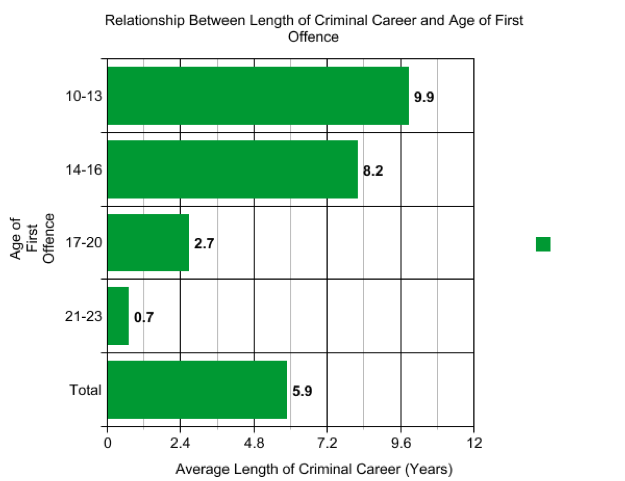
The risk factors associated with the developmental crime prevention theory are divided into:
- Biological/individual – typically inherent or personal factors such as impulsiveness and attention discrepancy.
- Family – inadequate supervision by the parents, domestic conflict as well as issues such as low income and large family, as children have an increased exposure to potentially delinquent siblings. 14% of the households in Starley Cross house dysfunctional families consisting of a lone parent and dependant children.
- Peer pressure – the socialisation theory argues that a child’s peer group is more momentous in shaping their adulthood behaviour in contrast to parental influence. Association with peers of negative and antisocial attitudes can promote an offending lifestyle in the future (Gewirtz and Stingle 1968).
- School – low attainment in school is also a major fabricator of high offending rates in the future, as low IQ is correlated to high delinquency rates (Mears and Cochran 2013). Starley cross is an embodiment of this, as the Starley Cross Junior School has a particularly low attainment rate, whereas the adult population suffers from high unemployment rates (over 18%).
- Neighbourhood – merely 62% of the Starley Cross inhabitants feel safe during night time, and furthermore rubbish and littering are the principle issues observed and communicated by the community of Starley Cross, raised by 48% of the area’s residents.
- Situational – the concept of low risk and high reward is likely to encourage individuals to engage in criminal behaviour as they are significantly more motivated as oppose to discouraged (Wright 2004).
 Starley Cross Community Safety Team